

Most people assume a flooded basement will cost a few hundred bucks to clean up. Wrong. In 2024, you’re looking at $2,000 to $5,000 for most jobs, and costs climb fast if contaminated water’s involved or you waited too long to start. The final bill depends on how deep the water got, what type of water it was, how long it sat, and what got ruined. Below, we’ll break down exactly what drives these costs, what different flooding scenarios actually run, and where your money goes during professional cleanup.
Average Pricing and Key Cost Factors for Basement Flood Cleanup

Most homeowners end up paying somewhere between $2,000 and $5,000 to clean up a flooded basement. But that range stretches pretty wide, from around $500 for basic water removal and drying on the low end, all the way to $25,000 or more when you’re dealing with serious floods and major structural damage. The national average for pulling out standing water and getting a basement dry sits between $3,000 and $5,000. Complete remediation, including all the repairs, typically runs $3,000 to $10,000. If you’ve got just a few inches of clean water in a small corner, you might get away with under $2,000. But let contaminated water cover your entire basement and soak into walls, floors, and everything you own? Costs climb fast.
These wild price swings aren’t about one thing going wrong. Multiple factors pile up together.
Severity level determines where you start. Minor basement flooding affecting less than 100 square feet typically costs $1,000 to $2,500, assuming you catch it quickly and the water’s clean. Moderate flooding covering your whole basement but causing minimal structural damage runs $3,000 to $5,000. Severe flooding with mold growth, structural repairs, and contaminated materials pushes costs to $6,000 to $10,000 or way higher. The difference isn’t just how much water showed up. It’s what that water touched, how long it sat there, and what got ruined.
Water depth and volume create your baseline costs. More water means longer extraction time, more ruined materials, higher labor bills. A basement with two inches of standing water needs way less pumping time than one with twelve inches. Shallow flooding rarely reaches electrical outlets, furnaces, or the upper sections of drywall. Deep water saturates more stuff, adds weight to your floors, and usually means tossing items that could’ve been saved with less exposure.
Most cleanup companies calculate estimates based on square footage, which makes sense when you think about it. Drying equipment, labor hours, materials, they all scale directly with the size of what got flooded. Larger basements take longer to dry, need more dehumidifiers and air movers, cost more for any material replacement. A 400 square foot basement runs roughly half what an 800 square foot space would for the same type and depth of flooding.
How long water sat before cleanup started seriously impacts damage and costs. Water sitting 24 hours causes more problems than water removed within a few hours. Materials soak up moisture, mold starts growing within 24 to 48 hours, structural stuff begins weakening. Water type matters just as much. Clean water from a broken pipe causes far less damage than contaminated water from a sewage backup, which needs specialized disposal and complete material replacement rather than drying and sanitizing.
Specific flooding scenarios and their typical costs:
- Clean water, small area (under 50 sq ft), immediate response: $500 to $1,000
- Clean water, full basement, caught within hours: $1,500 to $3,000
- Moderate contamination, medium area (200 to 400 sq ft), 12 to 24 hour delay: $3,500 to $5,500
- Significant water depth, full basement, clean source: $4,000 to $7,000
- Sewage contamination, any size area, material replacement required: $6,000 to $15,000 or more
| Severity Level | Description | Square Footage | Typical Cost Range |
|---|---|---|---|
| Minor | Less than 2 inches of clean water, limited area, minimal material damage | Under 100 sq ft | $1,000 to $2,500 |
| Moderate | Full basement coverage, clean to slightly contaminated water, some drywall and floor damage | Full basement, typical 400 to 800 sq ft | $3,000 to $5,000 |
| Severe | Deep water, contaminated source, extensive material damage, mold growth, structural concerns | Full basement with multiple systems affected | $6,000 to $10,000+ |
Water Contamination Categories and Professional Service Pricing

Water damage pros classify flooding into three categories based on contamination level. This classification drives both the cleanup approach and what you’ll pay. Category 1 represents clean water from sanitary sources, Category 2 involves gray water with some contamination, and Category 3 means black water with serious health risks.
Each category needs different safety protocols, equipment, disposal methods, and time investments. Those differences translate directly to different price points.
Category 1: Clean Water Flooding
Clean water comes from broken supply pipes, leaky faucets, overflowing sinks with potable water, or failed water heater connections. This water doesn’t pose immediate health concerns when it’s fresh, though it can degrade to Category 2 if it sits long enough to pick up contaminants from building materials or start growing bacteria. Pumping out and drying a basement with one inch of Category 1 water typically costs $500 to $1,500, with per square foot pricing reaching up to $3.75. Timeline runs about 1 to 2 days for water extraction using submersible or utility pumps, followed by 3 to 5 days of drying with industrial dehumidifiers and air movers. Common repairs include replacing water damaged drywall sections, treating or replacing affected flooring, repainting once everything dries completely. Most materials can be salvaged with Category 1 flooding if you act within 24 to 48 hours, which keeps costs lower. Think “broken pipe in winter while you’re away for the weekend.” You’ll need to rip out and replace the soaked drywall sections and possibly some flooring, but studs, joists, and most furnishings can be dried and saved.
Category 2: Gray Water Damage
Gray water contains small amounts of harmful chemicals or biological contaminants. It comes from sources like malfunctioning dishwashers, washing machines, toilet overflows without feces, or sump pump failures. This water can cause discomfort or illness if you contact it or consume it, so cleanup requires more safety precautions including protective gear. Restoration costs for Category 2 damage range from $3,000 to $5,000, with per square foot pricing around $4.50. Beyond extraction and drying, professionals must apply antimicrobial treatments to prevent bacterial growth, a process taking 1 to 2 additional days. Contaminated materials like carpet padding and lower sections of drywall usually need replacement rather than simple drying. Structural repairs often include replacing baseboards, lower drywall sections, and any insulation that got wet. Extra costs come from required sanitization steps and increased material disposal compared to Category 1.
Category 3: Black Water Contamination
Black water is the worst case scenario. Sewage backups, toilet overflows with feces, flooding from rivers or standing water, or any water that sat long enough to become grossly contaminated. This water contains dangerous pathogens, toxic chemicals, serious health risks. Any permeable or porous building material that contacts black water must be discarded and replaced. Period. Cleanup costs exceed $10,000 in most cases, with per square foot pricing reaching $7. Professionals need specialized training and equipment including hazmat suits, respirators, dedicated disposal protocols. Timeline extends to 2 to 3 weeks for complex cases because of the extensive demo and rebuild work. Major costs stack up fast. Furnace cleaning runs $50 to $150 if the unit can be salvaged, but repairs cost $300 to $2,000, and full replacement adds $4,000 to $6,000. You’ll likely face plumbing line replacement or extensive repairs, electrical wiring replacement for any circuits that got wet, mold remediation if the contaminated water sat for any length of time, and complete reconstruction of finished basement areas. Think “sewage backup that filled your basement with six inches of contaminated water.” You’re basically starting over with a gutted space.
| Water Category | Common Sources | Cost Per Sq Ft | Typical Total Range | Timeline | Common Repairs |
|---|---|---|---|---|---|
| Category 1 (Clean) | Broken pipes, leaky faucets, water heater failures | Up to $3.75 | $500 to $1,500 | 4 to 7 days | Drywall sections, flooring treatment, repainting |
| Category 2 (Gray) | Dishwashers, washing machines, sump pump failures | Around $4.50 | $3,000 to $5,000 | 6 to 9 days | Carpet padding, lower drywall, baseboards, antimicrobial treatment |
| Category 3 (Black) | Sewage backups, river flooding, toilet overflow with feces | Up to $7 | $10,000+ | 2 to 3 weeks | Complete material replacement, furnace repair or replacement, plumbing and electrical work, mold remediation |
Professional restoration companies follow a comprehensive five stage process regardless of water category, though intensity and duration of each stage varies by contamination level. Inspection comes first, using moisture meters that detect water inside walls and thermal imaging cameras that reveal hidden wet spots and temperature variations indicating moisture. Water extraction follows with high powered pumps and industrial wet vacuums that remove standing water within 1 to 2 days, working way faster than any homeowner equipment. Drying is the longest phase, running 3 to 5 days, using industrial grade air movers positioned strategically to maximize airflow across wet surfaces and commercial dehumidifiers that pull moisture from the air continuously. Sanitizing and antimicrobial treatments take 1 to 2 days, applying EPA approved disinfectants to kill bacteria and antimicrobial barriers to prevent mold growth. Final restoration includes replacing drywall, repainting, installing new flooring, and rebuilding any structural elements that were removed, requiring 1 to 2 weeks for standard jobs.
Professional equipment and technologies used in basement flood cleanup:
- Moisture meters (pin type and pinless) to measure water content in wood, drywall, and concrete
- Thermal imaging cameras to detect hidden moisture and map wet areas without demolition
- Submersible pumps and high volume extractors to remove standing water rapidly
- Industrial air movers (sometimes called blowers) positioned in calculated patterns for maximum drying efficiency
- Commercial dehumidifiers rated for specific cubic footage, running 24 hours to pull moisture from air and materials
- HEPA air scrubbers for Category 2 and 3 cleanup to prevent airborne contaminant spread
- Antimicrobial foggers and spray systems to treat large areas against mold and bacteria
Professional restoration becomes essential for Category 2 situations and absolutely non-negotiable for Category 3 black water contamination. The specialized equipment, safety training, proper disposal methods, and experience assessing hidden damage justify the higher cost compared to DIY approaches, especially when health risks exist.
DIY Basement Flood Cleanup Costs Versus Hiring Professionals
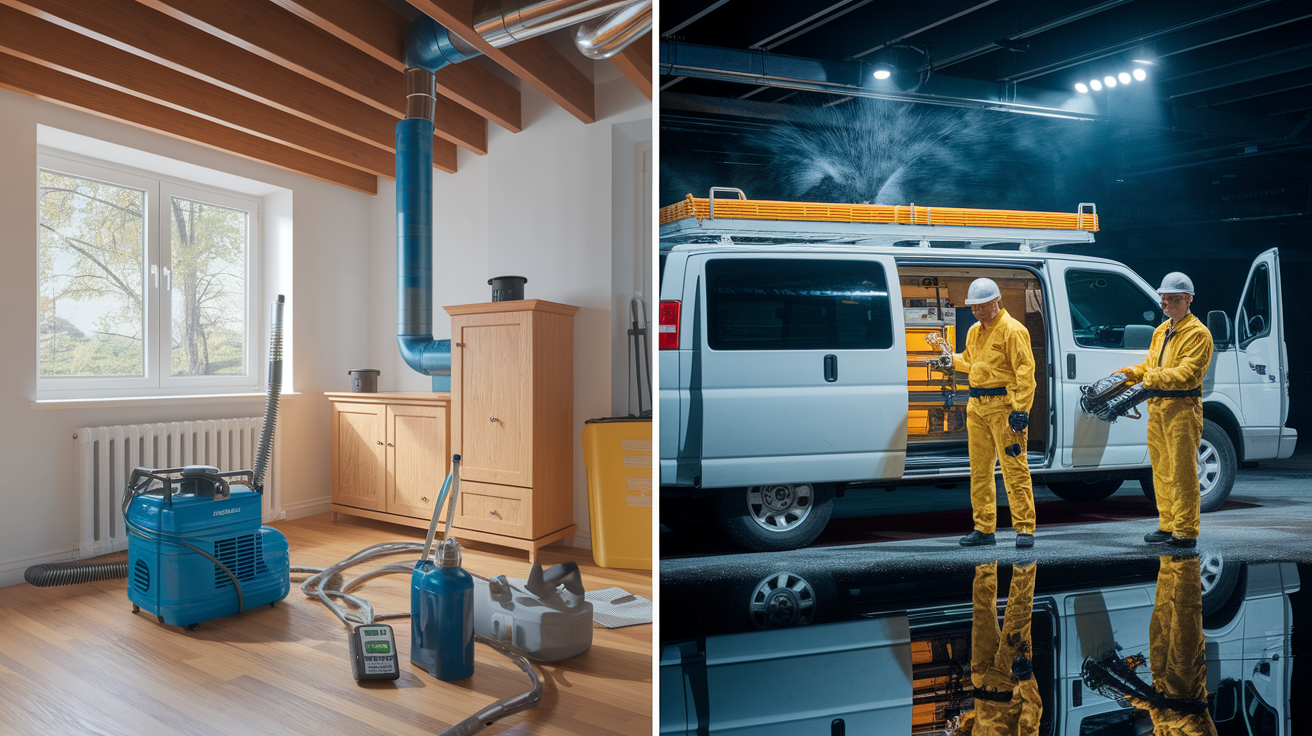
Tackling basement flood cleanup yourself can save money if you’re facing clean water, limited damage, and have the physical ability to handle the work.
DIY basement cleanup costs approximately $1,500 for the necessary pumping and drying equipment, assuming you purchase rather than rent. Portable utility pumps run $75 to $250 depending on capacity, with higher flow models costing more but finishing the job faster. You’ll need a large diameter discharge hose, adding $50 to $100. This matters more than you’d think because a narrow hose creates a bottleneck that slows your pump. Biggest expense is a professional grade dehumidifier at $800 to $1,200, and you really need this commercial capacity rather than a residential unit because basement drying requires pulling massive amounts of moisture from concrete, wood, and drywall simultaneously. Add moisture meters ($30 to $80), high volume fans ($50 to $150 each, and you need at least three), and miscellaneous supplies like extension cords, cleaning solutions, and safety gear.
The DIY approach works best for Category 1 clean water flooding under 200 square feet where you can start within a few hours of discovering the water. You’re looking at serious physical work. Moving furniture, hauling out soaked materials, running equipment continuously for days, monitoring moisture levels multiple times daily, handling all the cleanup and repairs yourself. Time investment runs substantial because you’ll spend a full day on extraction and initial setup, then check equipment twice daily for 3 to 5 days while drying happens, plus additional days for any repairs. DIY also means you’re responsible for knowing when materials can be saved versus when they must be replaced. Mistakes here lead to hidden mold growth months later. You won’t have thermal imaging to find hidden moisture or experience judging when structural elements are truly dry.
Professional services cost $2,000 to $10,000 but bring advantages beyond just doing the work for you. Restoration companies carry proper insurance, arrive with commercial grade equipment, work much faster than homeowners can, and document everything for your insurance claim. They know how to position air movers for maximum drying efficiency, understand exactly which materials must be replaced versus saved, and can identify moisture hidden inside walls without cutting holes everywhere to check. For clean water flooding from a broken pipe in a small area, you might reasonably handle it yourself if you act fast and have the equipment. Think “water heater supply line broke and you caught it within two hours, with under three inches of water in an unfinished basement.”
Several situations make professional service non-negotiable regardless of cost savings temptation. Any Category 2 or Category 3 water requires professionals due to contamination and health risks. If water reached your electrical panel, outlets, or any wiring, you need licensed electricians involved. Mold growth or mold smell means you’re past the DIY window. Structural concerns like sagging floors, cracks in foundation walls, or water coming through the foundation itself need expert assessment. Water damage exceeding a few gallons or covering more than 200 square feet overwhelms homeowner equipment capacity. If you have any doubt about the water source or contamination level, call professionals. Cleaning up Category 2 water with Category 1 methods creates health risks.
For DIY home repairs, knowing your limits matters as much as knowing your capabilities. Flooded basement cleanup pushes most homeowners past those limits quickly when contamination or volume increases.
Essential DIY equipment with individual costs for clean water basement flooding:
- Submersible or utility pump (1/3 HP to 1/2 HP capacity): $75 to $250
- Discharge hose (1.5 inch to 2 inch diameter, 50 to 100 feet): $50 to $100
- Commercial dehumidifier (rated for basement square footage): $800 to $1,200
- High volume floor fans (at least 3 units): $50 to $150 each
- Moisture meter (pin type for measuring material wetness): $30 to $80
Insurance Coverage and Out-of-Pocket Expenses for Flood Damage

Insurance coverage often determines whether basement flood cleanup causes financial stress or manageable inconvenience, so understanding your policy before water shows up matters.
Standard homeowners insurance policies typically cover sudden and accidental water damage like burst pipes, ruptured water heater tanks, and overflowing appliances such as dishwashers or washing machines. These policies treat the water damage as part of a covered plumbing failure event. If your water supply line cracks and floods your basement, your homeowners policy should cover the water removal, drying, and repairs minus your deductible. Same goes for a washing machine hose that fails during a cycle or a dishwasher that malfunctions and spills water across your basement floor. The key words are “sudden and accidental.” The damage had to happen unexpectedly, not gradually over time due to neglect.
Standard homeowners policies almost always exclude several flooding scenarios that homeowners assume are covered until they file a claim. Natural flooding from heavy rain, overflowing rivers, storm surge, or snowmelt typically isn’t covered under regular homeowners insurance. Sewage backups and sump pump failures get excluded in most standard policies unless you purchased optional endorsements specifically adding this coverage. Damage from poor maintenance gets denied. If your insurance company determines you neglected obvious leaks or failed to maintain your plumbing, they’ll reject the claim. Water seeping through foundation cracks or coming up through the floor often gets classified as groundwater intrusion, which standard policies exclude.
Separate flood insurance through the National Flood Insurance Program or private flood insurers becomes necessary for comprehensive protection against natural flooding events.
For successful insurance claims, documentation makes the difference between quick payment and lengthy disputes. Take photos and videos of the water damage before you touch anything, capturing water levels, affected areas, and damaged belongings. Keep all service records and invoices from restoration companies, equipment rentals, and repairs. Document the timeline when you discovered the water, when you stopped the source, when cleanup began. Your insurance adjuster needs this information to process the claim fairly.
Essential documentation steps for basement flood insurance claims:
- Photograph water at its highest level and all affected areas before cleanup begins
- Video record the extent of flooding and any visible damage to structure and belongings
- Document the water source if you can identify it (broken pipe, failed appliance, foundation crack)
- Keep receipts for emergency services, equipment rentals, restoration companies, and all repairs
- Write down the discovery timeline, when flooding started, when you found it, when professionals arrived
- Save written estimates from multiple restoration companies even if you only hire one
Regional and Local Pricing Variations for Flood Cleanup

Your location significantly affects what you’ll pay for basement flood cleanup beyond the obvious factors of water type and damage severity.
Urban areas typically charge more than rural locations for the same cleanup work because of higher labor costs, more expensive business overhead, and increased cost of living affecting all service pricing. A restoration company in a major metropolitan area pays more for warehouse space, vehicles, insurance, and employee wages, which flows directly to customer invoices. Conversely, rural areas might offer lower hourly rates but could add substantial travel charges if you’re far from the nearest qualified restoration company. Urban customers usually benefit from more competition between restoration companies, which can moderate pricing, while rural customers might face limited options that reduce negotiation opportunities.
Regional factors like climate, flood frequency, and seasonal weather patterns influence both baseline pricing and contractor availability. Areas prone to flooding typically have more restoration companies competing for work during normal periods, which keeps prices reasonable, but rates spike during emergencies when multiple properties flood simultaneously. Coastal areas and regions near rivers invest more heavily in flood response infrastructure, which can mean faster response times but also higher baseline costs. Cold climates face additional complications when pipes freeze and burst during winter, and restoration companies often charge premium rates during cold snaps when dozens of properties flood at once. Markets with high demand and limited qualified contractors can command significantly higher rates than areas with stable, predictable water damage incidents.
Emergency services and after hours response typically add 20% to 50% to standard pricing, and for good reason. Restoration companies maintaining 24 hour availability carry higher operating costs, and technicians responding at 2 AM on a Sunday earn overtime wages. But emergency response also prevents damage from getting worse. Water sitting overnight causes more problems than water addressed immediately. If you discover flooding at 11 PM on a holiday weekend, expect premium pricing but faster damage mitigation that often saves money overall by reducing total repair costs.
Regional factors that increase basement flood cleanup costs:
- Urban locations with high cost of living and expensive commercial real estate
- Areas experiencing active flooding that overwhelms local restoration company capacity
- Regions requiring specialized licensing or insurance for water damage restoration work
- Remote rural locations far from equipment suppliers and qualified contractors
- Markets with limited competition and few certified restoration companies
Getting Accurate Quotes and Choosing Restoration Contractors

Getting multiple quotes from reputable contractors prevents overpaying and helps you understand what fair pricing looks like for your specific situation.
A detailed estimate should break down costs by category rather than providing a single lump sum. Expect line items for water extraction including equipment and labor hours, drying equipment rental or usage fees listed separately from labor, antimicrobial treatments if needed, material disposal costs, specific repairs like drywall replacement with square footage and material costs itemized, painting and finishing work, and any additional services like mold testing or structural assessments. Red flags include quotes that seem unusually low compared to others without clear explanation, contractors who pressure you to sign immediately without allowing time to compare options, estimates that lump everything into vague categories like “remediation services,” and companies unwilling to provide references or proof of insurance. If someone quotes your entire basement flood cleanup at $800 when others are quoting $3,500 for similar work, they’re either planning to cut corners, add charges later, or lack proper equipment and training.
Many restoration companies offer free inspections, and these are often legitimate marketing tools that benefit both parties.
Contractor qualifications matter more for water damage than many other home repairs because of health and safety implications. Verify the company carries proper insurance including general liability and workers’ compensation. You don’t want liability if someone gets hurt working in your flooded basement. Look for IICRC certification (Institute of Inspection Cleaning and Restoration Certification), which means technicians completed industry standard training in water damage restoration, structural drying, and microbial remediation. Check online reviews focusing on recent feedback about similar projects rather than just overall star ratings. Ask how long the company has been in business. Startups aren’t automatically bad, but established companies demonstrate staying power and usually have more extensive equipment and expertise. Verify they have experience with your specific water category and damage type, because Category 3 sewage cleanup requires different skills than Category 1 pipe burst.
Ask contractors targeted questions during the evaluation process to gauge competence and compatibility. How long will the entire process take from start to final repairs? What specific equipment will you use, and how many dehumidifiers and air movers will you set up? How do you determine when materials can be dried versus when they must be replaced? What’s your process for hidden moisture detection? Will you provide daily updates and access to check progress? How do you handle insurance documentation and what information will you provide for my claim? Do you guarantee your work, and what does that guarantee cover? What’s your timeline for responding to questions or issues after the initial work completes? The answers reveal whether the contractor uses professional approaches or cuts corners, and whether they communicate clearly or hide behind technical jargon.
Essential elements every detailed basement flood cleanup quote should contain:
- Itemized water extraction costs separating equipment and labor
- Specific drying equipment to be used with daily or weekly rental/usage costs
- Square footage being treated and per square foot pricing for major services
- Material disposal fees and estimated disposal volume
- Detailed repair costs breaking down materials, labor, and specific work to be performed
- Antimicrobial treatment costs if applicable to your water category
- Estimated timeline with milestones for extraction completion, drying completion, and final restoration
Preventing Future Floods and Long-Term Cost Savings
Investing in flood prevention measures costs far less than repeatedly paying for cleanup and repairs. These improvements usually add property value that exceeds their installation cost.
Sump pump systems represent your primary defense against basement flooding in most homes, and a quality system with battery backup runs $800 to $2,500 installed. The battery backup component adds $400 to $800 but keeps your pump running during power outages that often accompany heavy storms. Primary sump pumps themselves cost $150 to $600 depending on capacity and features, with installation adding another $250 to $500 if you’re hiring professionals. A water powered backup sump pump offers an alternative to battery systems, using municipal water pressure to operate when electricity fails, costing $200 to $400 installed. The investment pays for itself if it prevents even one moderate flooding event. Remember that $3,000 to $5,000 cleanup cost for a flooded basement. Annual maintenance including testing the float switch, cleaning the inlet screen, and verifying the discharge line drains properly costs nothing but 20 minutes of your time twice yearly.
Foundation and drainage solutions address water before it reaches your basement, tackling problems at the source. Proper yard grading that slopes away from your foundation costs $500 to $3,000 depending on how much dirt needs moving and whether you hire landscapers or rent equipment for DIY work. French drain systems installed along your foundation perimeter run $2,000 to $8,000 depending on length and depth, but they intercept groundwater and route it away before it can seep through foundation walls. Foundation crack sealing varies widely by crack size and repair method. Simple DIY epoxy or polyurethane injection for minor cracks costs $50 to $200 in materials, while professional foundation crack repair runs $400 to $1,500 per crack depending on length and severity. Exterior waterproofing solutions including excavation, membrane installation, and drainage systems represent major investments at $8,000 to $15,000 or more, but they solve persistent seepage problems that cause repeated flooding.
Regular maintenance tasks prevent many common flooding causes and cost almost nothing beyond time and attention. Clean gutters and downspouts at least twice yearly, in spring and fall, ensuring water flows away from your foundation rather than dumping next to basement walls. Neglected gutters overflow during heavy rain and direct thousands of gallons directly toward your foundation. Inspect your sump pump every few months by pouring water into the sump pit to verify the pump activates and discharges properly. Check washing machine hoses annually and replace them every five years regardless of appearance. Rubber hoses fail suddenly after aging, while braided stainless hoses last longer. Look for plumbing leaks, water stains, and signs of moisture regularly, addressing small problems before they become flooding events. Test your GFCI outlets and verify they trip properly, protecting you from electrical issues if water does reach outlets.
Basement waterproofing increases property resale value beyond the improvement cost in many markets, particularly in areas where buyers specifically worry about basement moisture. A well maintained, demonstrably dry basement with quality waterproofing systems appeals to buyers and often returns 50% to 80% of the investment cost when you sell.
| Prevention Measure | Typical Cost | Potential Savings |
|---|---|---|
| Sump pump with battery backup | $800 to $2,500 installed | Prevents $3,000 to $10,000 flooding cleanup costs |
| Yard grading and drainage improvement | $500 to $3,000 | Eliminates recurring surface water seepage costing $1,500 to $4,000 per incident |
| Foundation crack sealing | $400 to $1,500 per significant crack | Stops water entry that causes $2,000 to $5,000 in damage annually |
| French drain system | $2,000 to $8,000 | Prevents repeated flooding costing $3,000 to $7,000 every few years |
| Regular maintenance (gutter cleaning, pump testing) | $0 to $300 annually if you hire services | Avoids emergency repairs and extends equipment life, saving thousands long term |
Final Words
Basement flood cleanup cost depends heavily on water contamination level, square footage, and how long moisture sat before you started mitigation.
Clean water from a burst pipe might run $500 to $1,500 for a quick pump-and-dry. Gray water from an appliance pushes costs into the $3,000 to $5,000 range. Black water contamination from sewage can exceed $10,000 with all the required replacement work and safety protocols.
Getting multiple quotes, understanding your insurance coverage, and investing in prevention like sump pumps and proper grading will save you serious money over time.
FAQ
How much does it cost to clean up a flooded basement?
The cost to clean up a flooded basement typically ranges from $2,000 to $5,000 for most homeowners, though prices can vary from $500 for minor clean water incidents to over $10,000 for severe sewage contamination requiring structural repairs.
Will homeowners insurance cover a flooded basement?
Homeowners insurance will cover a flooded basement when water damage results from sudden plumbing failures like burst pipes or appliance malfunctions, but natural flooding from storms requires a separate flood insurance policy to receive coverage.
How much does it cost to fix a flooding basement?
The cost to fix a flooding basement ranges from $3,000 to $10,000 on average, with minor repairs under $2,000 and substantial flood damage with structural repairs potentially exceeding $25,000 depending on damage severity and water contamination type.
How much does it cost to pump water out of a basement?
The cost to pump water out of a basement starts around $500 for basic clean water removal and can exceed $10,000 when extraction includes contaminated water, extensive drying with industrial dehumidifiers, and antimicrobial treatments to prevent mold.
What determines the final cost of basement flood cleanup?
The final cost of basement flood cleanup is determined by water contamination category, basement square footage, water depth and volume, time water remained standing, affected materials requiring replacement, and whether structural or electrical repairs are needed.
How long does professional basement flood cleanup take?
Professional basement flood cleanup takes four to six days for standard jobs, with water extraction requiring one to two days and drying with dehumidifiers taking three to five days, though severe sewage contamination cases may extend to two or three weeks.
What is the difference between Category 1, 2, and 3 water damage costs?
Category 1 clean water damage costs $500 to $1,500 and comes from broken pipes, Category 2 gray water from appliances costs $3,000 to $5,000, and Category 3 black water from sewage exceeds $10,000 due to hazardous contamination requiring specialized treatment.
Is DIY basement flood cleanup worth the cost savings?
DIY basement flood cleanup is worth the cost savings only for minor clean water incidents under 100 square feet, costing around $1,500 for equipment rental, but contaminated water or extensive damage requires professional services costing $2,000 to $10,000 for safety.
Does flood insurance cover sewage backup in basements?
Flood insurance does not automatically cover sewage backup in basements unless specifically added as a separate endorsement, while standard homeowners policies typically exclude both natural flooding and sewer-related water damage without additional coverage riders.
What preventive measures reduce future basement flooding costs?
Preventive measures that reduce future basement flooding costs include installing battery backup sump pumps, grading yards away from foundations, sealing foundation cracks, maintaining gutters and downspouts, and adding French drains to redirect water flow permanently.