

Most gutter leaks cost $100 to $225 to fix professionally, but that “simple” drip off your roofline can spiral fast if you don’t catch what’s actually broken. A lot of homeowners call about one visible leak and discover three more seam failures, rotted fascia behind the gutter, or rusted-through metal that needs a full section replacement. This guide breaks down what you’ll actually pay per leak, which repair methods match which problems, and when a $15 tube of sealant works versus when you’re looking at a $400 bill.
What You’ll Pay for Gutter Leak Repairs: Complete Cost Breakdown

Most single-story homeowners pay between $100 and $225 for professional gutter leak repairs. That range covers the usual suspects: a few small holes, seam separation along 10 to 15 feet of gutter, or joint leaks at corner connections. What you’ll actually pay depends on how your contractor bills. Some quote per leak ($50 to $125 for each problem spot), others charge per linear foot ($1.50 to $6.50 for seam sealing or $1 to $2 for metal flashing patches), and many just use hourly rates of $50 to $150. Almost all contractors have minimum service fees between $75 and $200, which usually covers the first hour of work plus a basic inspection.
Professional labor makes up about 60% to 70% of your total cost. Materials account for the rest. That minimum service fee covers the truck roll, ladder setup, safety equipment, and initial assessment. If your repair takes less than an hour, you’re still paying the minimum. If it runs longer, hourly charges kick in after that first hour. For straightforward leak repairs on accessible first-floor gutters, most jobs wrap up within that initial service window.
| Repair Scope | Professional Cost | DIY Material Cost |
|---|---|---|
| Single small hole (roofing cement) | $100 to $175 | $12 to $20 |
| Seam sealing for 10 linear feet | $115 to $165 | $15 to $30 |
| Metal flashing patch for 5 feet | $105 to $185 | $20 to $35 |
| Multi-leak repair on standard home (3-4 spots) | $225 to $400 | $40 to $75 |
| 2-story home leak repair (accessibility premium) | $250 to $500 | $40 to $75 (plus ladder rental) |
If you’re comfortable with ladder work and want to handle simple leaks yourself, you’ll spend $30 to $75 on materials for typical repairs. Gutter sealant tubes run $8 to $15 each (one tube covers about 10 to 15 feet of seam), basic patch kits cost $10 to $25, roofing cement is $12 to $20 per container, and metal flashing strips are $15 to $30 for a 10-foot section. Add another $25 to $40 if you need to buy a caulk gun, putty knife, and wire brush. Check out our DIY Home Repair Guide for material selection tips and application techniques that prevent common beginner mistakes.
Most homeowners end up paying between $150 and $300 for professional leak repairs when everything’s factored in. DIY approaches cut costs to $30 to $75 in materials, but you’ll need safe ladder setup, proper surface prep, and the right technique to keep those leaks from coming back.
Key Variables That Determine Your Final Repair Price

The material your gutters are made from has a big impact on repair pricing. Vinyl and PVC systems are the most budget-friendly to fix, typically running $75 to $200 for standard leak repairs. Aluminum gutters sit in the middle range. Copper and zinc systems cost considerably more, ranging from $125 to $325 for similar work, because they require specialized soldering tools, specific patching materials that match the metal’s properties, and contractors trained in working with premium materials. Expect to pay 30% to 50% more for repairs on premium materials compared to vinyl or PVC, even when the actual leak is identical in size and location.
Your home’s characteristics and gutter sizing also drive costs. Single-story homes establish the baseline pricing you’ll see quoted most often. Two-story homes typically double those costs because of extended ladder work, additional safety equipment, and slower work pace at height. Gutter size matters too. Standard 5-inch systems are priced as shown in most estimates, but 6-inch and 7-inch gutters cost 20% to 30% more to repair because they use more material per linear foot and often require custom-cut patches. The number of separate leaks compounds costs quickly, since each problem spot needs individual attention even if they’re close together.
| Leak Location | Typical Repair Method | Cost Range |
|---|---|---|
| Seam leaks | Sealant application | $1.50 to $6.50 per linear foot |
| Corner joints | Re-caulking and sealing | $75 to $150 per corner |
| Downspout connections | Outlet replacement | $30 to $75 per connection |
| Rust holes in gutter body | Metal flashing patch | $1 to $2 per linear foot |
| End cap failures | Cap replacement and sealing | $50 to $100 per cap |
| Gutter body cracks | Roofing cement or epoxy | $100 to $175 per crack |
Where the leak happens determines both the complexity and cost of the fix. Seam leaks are the most common problem and usually the least expensive to address, just requiring thorough cleaning and fresh sealant application along the joint. Downspout connection issues often need partial or complete outlet replacement rather than simple patching, which pushes costs higher. Corner and miter joints are tricky because they’re high-stress areas where two sections meet at an angle. They require precise resealing with the right bead thickness and proper curing time, or the leak returns within months. Fascia-mounted hangers near leak spots sometimes need replacement too, since water damage weakens the mounting point.
Multiple cost factors typically combine on any given repair. A seam leak on a two-story copper gutter system will hit you with the material premium, the height surcharge, and potentially hanger replacement costs all at once.
Seamless Gutter Leak Repairs Cost More Than Sectional

Seamless gutters cost $150 to $750 to repair, while sectional systems run $100 to $450 for comparable leak fixes. That price difference comes down to how each system is built. Seamless gutters are custom-formed on-site from a single piece of metal, which means they have no joints except at corners and downspout connections. When damage happens, you often can’t just patch a small section. Many contractors need to replace the entire run from corner to corner because cutting and rejoining seamless gutters requires specialized equipment mounted on a truck. Small leaks sometimes get patched, but cracks, dents, or corrosion spots often mean replacing 20, 30, or 40 feet of gutter even when the damage covers just 2 or 3 feet.
Sectional gutters give you a repair cost advantage in most situations. Each section is typically 10 feet long and connects to the next with slip joints and sealant. When one section develops a leak, crack, or rust hole, contractors can remove just that damaged 10-foot piece and snap in a replacement. The parts are standardized and available at most home centers, keeping material costs down. DIY repairs are more feasible too, since you’re working with manageable 10-foot sections rather than trying to patch custom-formed continuous metal. Labor time drops because there’s no specialized forming equipment involved.
Despite costing more per repair visit, seamless gutters develop fewer leaks over their lifespan. Those slip joints on sectional systems are natural weak points where sealant breaks down and water finds gaps. Seamless systems eliminate most of those vulnerable spots. If you’re dealing with an aging system that needs frequent repairs, that calculation shifts. Three $125 repairs on sectional gutters in five years ($375 total) might cost less than one $400 seamless gutter run replacement in that same period.
Additional Damage That Increases Leak Repair Bills
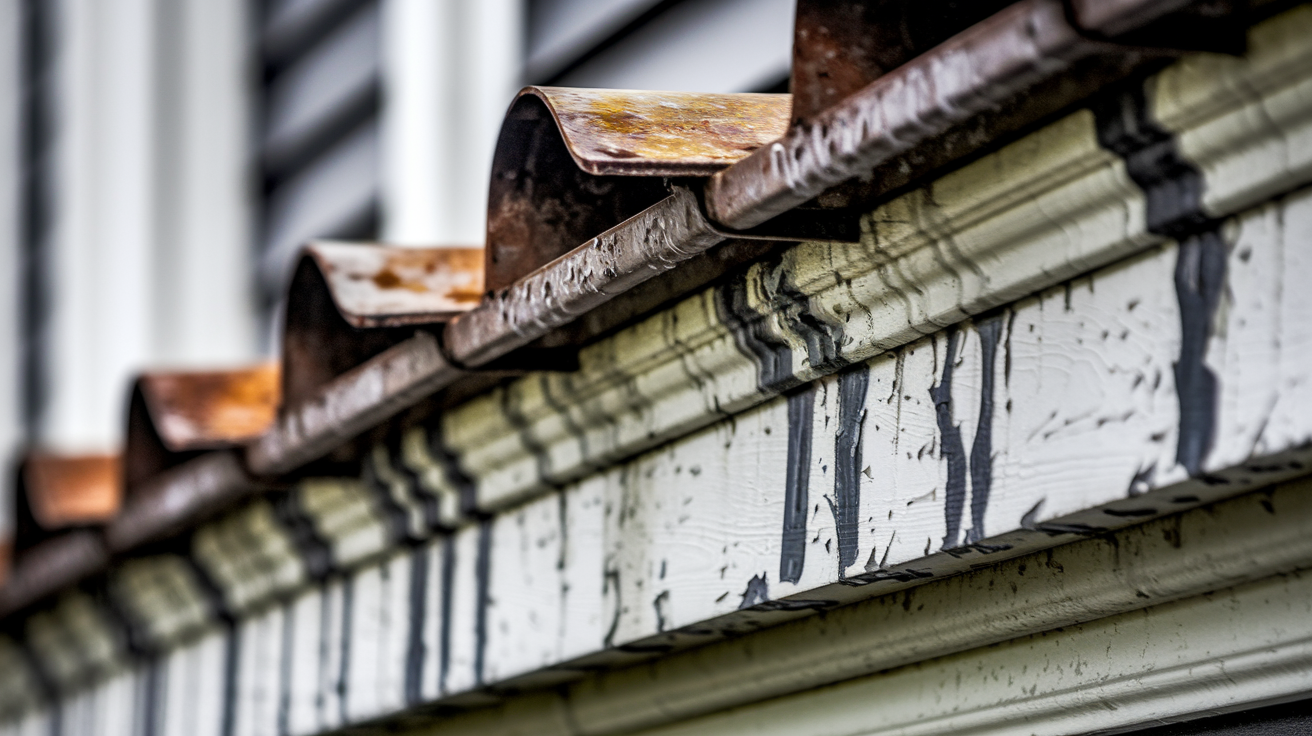
Gutter leaks rarely exist in isolation. By the time you notice water dripping or staining, damage has often spread beyond the gutter itself.
The most common collateral damage happens to the fascia board, that vertical trim board your gutters attach to. Constant water exposure from leaking gutters causes wood rot, which means that board needs replacing before new gutters or patches can go up properly. Fascia replacement costs $4 to $22 per linear foot depending on material and accessibility. Soffit panels (the horizontal boards under your roof overhang) can deteriorate too when water runs down the fascia and soaks the soffit from above. Siding below the leak point often shows water staining, peeling paint, or actual rot damage. Siding repairs run $2 to $14 per square foot when water infiltration has caused problems. These aren’t optional cosmetic fixes. Mounting gutters to rotted fascia or leaving damaged siding in place just sets you up for more expensive problems later.
Hanger and bracket failures both cause and result from gutter leaks. When water pools in a gutter because of improper pitch, the extra weight stresses mounting brackets. When brackets fail, the gutter sags and creates low spots where water sits instead of draining, which leads to leaks. Replacing hangers costs $2 to $3 per bracket plus $50 to $150 per hour for the labor to remove old hardware, patch mounting holes if needed, and install new brackets at proper spacing. A typical repair might need 5 to 8 new hangers along a problem section.
Watch for these warning signs that indicate damage beyond the leak itself:
- Dark staining or discoloration on exterior walls below the gutter line
- Paint peeling or bubbling on fascia boards or siding near gutters
- Soft or spongy wood when you press on fascia or soffit areas
- Water pooling against your foundation or basement moisture after rain
Addressing leaks quickly prevents that damage from spreading. Ignoring a leaking or clogged gutter system causes an average of $8,000 in water damage to foundations, basements, and structural components. For context on what that water infiltration can do, check out Water Damage Restoration Basics to see why catching gutter problems early matters.
When Leak Repair Isn’t Worth It and Replacement Makes Sense
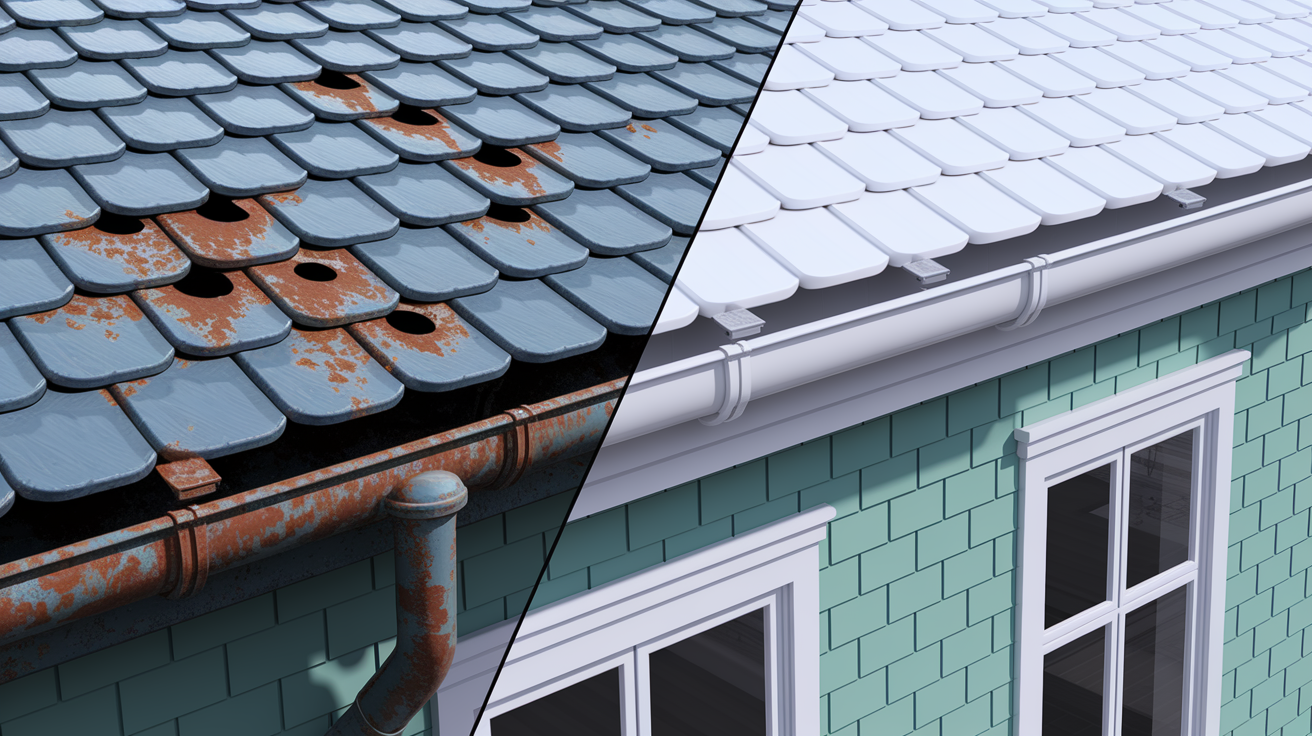
Sometimes patching leaks is just throwing good money after bad.
The rule of thumb is straightforward: if your repair estimate exceeds 50% of what full replacement would cost, or if you’re dealing with multiple separate leak locations across the system, replacement usually makes better financial sense. One or two isolated leaks on an otherwise sound gutter system are worth fixing. Three or more problem spots, or repeated repairs in the same areas, signal that the entire system is failing.
Here’s when replacement beats repair:
Your gutters have exceeded their expected lifespan (20 to 30 years for steel and aluminum, 50 plus years for copper systems). You’ve got three or more separate leak locations that need attention. Visible rust, corrosion, or deterioration appears throughout the system, not just at leak points. Multiple sections are sagging despite having adequate hangers. You’ve paid for repairs in the same spots twice within three years. Water damage has already reached the fascia, soffit, or foundation from ongoing leaks.
Compare the numbers directly. A typical leak repair runs $100 to $450 depending on scope and access. Full gutter replacement costs $12 to $25 per linear foot, or $900 to $2,550 for 150 linear feet of new gutters on an average home. If you need repairs on 20 or more linear feet of gutter, or if multiple separate problem areas exist, you’re approaching $400 to $600 in repair costs. At that point, you’re spending 25% to 40% of replacement cost to fix an aging system that will likely develop new leaks within a year or two.
Material lifespan matters here too. If your aluminum gutters are 25 years old and springing leaks, they’ve lived a full life. Patching them now buys you maybe two to four more years before the next failure. Replacement gives you another 20 to 30 years of service.
Regional and Seasonal Factors Affecting Repair Pricing

Where you live and when you schedule the work both affect what you’ll pay for gutter leak repairs.
Regional cost variations follow local labor markets and cost of living. Urban and coastal markets typically run 15% to 25% higher than rural or inland areas for the same repair work. A $150 leak repair in a small Midwest town might cost $190 to $215 in a major metro area or coastal city. That difference comes from higher wages, increased business operating costs, and stronger demand for contractors in densely populated areas. Material costs stay fairly consistent nationally, but labor rates vary based on local economic conditions.
Seasonal timing affects pricing and availability. Fall is peak season for gutter work because homeowners want systems cleaned and repaired before winter weather hits. Contractors stay busy from September through November, and some charge premium rates during this high-demand window. Emergency repairs during active storms or in freezing conditions can add 50% to 100% to standard rates, but sometimes you don’t have a choice when water is actively pouring into your house. Winter months (December through February in most regions) often see discounted pricing because demand drops. If you’ve got a leak that isn’t causing active damage, waiting for winter to schedule the repair can save 10% to 20% off peak-season pricing.
Climate impacts what breaks and how often. Northern regions with freeze-thaw cycles see more leak-related damage because water trapped in gutters freezes, expands, and stresses seams and joints. Ice dams that form along roof edges can back water up under shingles and into gutters, causing leaks that wouldn’t happen in milder weather. Southern and humid climates accelerate corrosion and rust, particularly on steel gutters, which means more frequent leak repairs but from different causes. Material choice matters more in harsh climates. Copper and aluminum hold up better in corrosive coastal air than steel, while vinyl becomes brittle in extreme cold.
Emergency repairs during active leaks or storms command premium pricing, but delaying can mean water damage that costs far more than the emergency rate surcharge.
Preventing Future Leaks to Avoid Repair Costs

Prevention costs far less than repeated repairs. A proactive maintenance approach keeps small problems from becoming expensive leaks.
The basic maintenance schedule is straightforward: clean gutters twice yearly, once at the end of fall after leaves drop and again in late spring after tree seeds and blossoms finish falling. Professional gutter cleaning costs $100 to $250 per service, or $0.50 to $2.50 per linear foot. Many companies include a basic inspection with cleaning, checking for early signs of separation at seams, loose hangers, and developing rust spots. Those free inspections catch problems when they’re cheap to fix. A $15 tube of sealant applied to a separating seam during a routine cleaning prevents a $150 leak repair six months later. Storm debris removal matters too. After heavy winds or nearby tree damage, a quick visual check and debris clearing prevents clogs that lead to overflow and leak-causing stress on gutter joints.
DIY maintenance and prevention tasks you can handle safely:
Clear downspouts monthly by running a hose from the top, watching for slow drainage that indicates partial clogs. Check seams and joints twice yearly for early separation, catching gaps before they become leaks. Remove or trim back tree branches that overhang gutters by more than 3 feet. Verify proper slope by watching water flow during light rain (it should move steadily toward downspouts, not pool). Tighten loose hangers when you spot them, before the gutter sags enough to create drainage problems. Apply fresh sealant to vulnerable joints and corners annually, focusing on spots that showed minor seepage. Clean debris with proper safety equipment (stable ladder, work gloves, eye protection, and someone nearby).
Are Gutter Guards Worth the Investment?
Gutter guard systems reduce leak risk by preventing the clogs that cause water to pool and stress seams. Initial installation costs run $15 to $45 per linear foot, or $3,000 to $9,000 for a complete system on an average home. Professional installation can reach $5,000 for 200 linear feet of premium guards. The three main types are mesh screens (fine metal mesh that blocks debris), foam inserts (porous foam that fills the gutter channel), and reverse-curve systems (shaped covers that use surface tension to pull water in while deflecting leaves). Performance varies by type and local conditions, but 84% of homeowners surveyed reported satisfaction with their gutter guard systems.
Guards don’t eliminate maintenance entirely. You still need annual inspections and occasional cleaning when small debris works through the screen or builds up on top. But they typically reduce cleaning frequency from twice yearly to once every two to three years. The investment pays off in three to five years of avoided cleaning costs ($200 to $500 saved) and prevented leak repairs. For homes surrounded by trees or in areas with heavy seasonal debris, guards make strong financial sense and can extend gutter system lifespan.
Finding and Hiring a Qualified Gutter Repair Contractor

Start with contractors who carry proper licensing for your state and general liability insurance that covers property damage during repairs. Ask for proof of both before getting estimates.
Getting accurate estimates requires asking three to five contractors to assess your leak problem in person. Written estimates should itemize labor costs, materials with specific products listed, disposal fees if they’re removing damaged sections, and any related work like fascia repair or downspout replacement. Most contractors offer free inspections and estimates, but be aware that minimum service fees of $75 to $200 apply once actual repair work begins. Those fees typically include one hour of work, so if the inspection reveals a simple fix, some contractors will handle it during that initial visit and just charge the minimum. Others separate the estimate visit from the repair appointment.
Ask these questions before hiring:
How many years have you worked with gutters like mine (material and style)? What warranty do you provide on labor and on the materials you install? Can you provide proof of liability insurance and workers compensation coverage? Can I contact three references from gutter repair jobs completed in the last six months? Do you handle related repairs like fascia boards, soffit panels, and downspout rerouting, or will I need separate contractors?
Red flags that should make you walk away include estimates that are 30% or more below other quotes without clear explanation of why (often indicating hidden charges, substandard materials, or corners cut on proper prep work), pressure to decide immediately without time to review the written estimate, reluctance to provide a detailed written contract, requests for cash-only payment or full payment upfront, and no permanent business address or office phone number. Legitimate contractors understand that you need time to compare estimates and make an informed decision.
Emergency repairs cost more because of after-hours rates and urgent response, but they’re necessary when active leaks threaten interior damage or when storm damage has left gutters hanging loose. Expect to pay 50% to 100% above standard rates for same-day emergency service, but that premium prevents water infiltration that would cost far more to remediate.
Understanding Warranties and Guarantees on Leak Repairs

Warranty coverage varies between contractors and materials, so get the terms in writing before work starts.
Standard labor warranties from reputable contractors typically run one to two years for repair work, though some offer longer coverage on extensive repairs or full section replacements. Those warranties cover workmanship issues like sealant that was improperly applied, patches that separate, or hangers that pull loose because of incorrect installation. They don’t cover normal wear from weather exposure, new damage from storms or falling debris, or failures that result from neglected maintenance like clogged gutters that overflow. Read the warranty language carefully to understand what specific circumstances are excluded. Some contractors void warranties if you don’t maintain a regular cleaning schedule or if someone else works on the system during the warranty period.
Material warranties come from manufacturers rather than contractors. Gutter sealants typically carry five to ten year warranties against cracking, separation, or adhesion failure under normal conditions. Metal flashing patches are usually warranted for 15 to 20 years, matching the expected lifespan of the gutter material itself. Replacement gutter sections carry the same manufacturer warranty as new installation, which varies by material. Keep all warranty paperwork and product receipts, since you’ll need them to make claims if problems develop.
Proper maintenance is almost always required to keep warranties valid. That usually means annual cleaning at minimum, and immediate attention to new damage or developing problems rather than letting them worsen. Most warranty language includes a clause requiring “reasonable care” or “proper maintenance” of the gutter system. If you ignore obvious clogs or let debris pile up for multiple seasons, don’t expect warranty coverage when failure happens.
DIY repairs carry no warranty beyond the product guarantees on materials you purchase. If your patch fails or the sealant doesn’t hold, you’re starting over on your own time and dollar. That lack of warranty protection is why professional service makes sense for major leak problems or recurring issues in the same location. Paying $150 to $200 for a repair with a one-year labor warranty beats spending $40 on DIY materials three times in eighteen months.
Money-Saving Strategies for Gutter Leak Repairs

Smart timing and the right approach can cut what you spend on leak repairs without compromising quality.
Schedule non-emergency repairs during off-peak seasons to access lower rates. Winter and early spring (January through March in most regions) are slow months for gutter contractors, and many discount rates by 10% to 20% to stay busy. If you’ve got a leak that isn’t causing active interior damage or foundation problems, waiting a few months to schedule the fix saves money. Bundle multiple exterior home projects with the same contractor when possible. If you need gutter repairs and also want fascia painting, new downspout extensions, or soffit work, doing it all at once often gets you a volume discount of 5% to 15% on the total bill. Address small leaks immediately rather than waiting. A $15 tube of sealant applied to a minor seam separation prevents a $150 full repair six months later when that small gap has opened into a major leak.
Five practical ways to reduce repair costs:
Handle simple sealant and caulk applications yourself when the leak is accessible from a stable ladder and doesn’t require fascia removal or metal patching. Combine leak repair appointments with scheduled cleaning to get full value from the minimum service fee rather than paying it twice. Get three to five written estimates and use the detailed breakdowns to negotiate with your preferred contractor. Ask about payment plans for repairs over $500, since many contractors offer interest-free terms for 90 days. Check whether your homeowner’s insurance covers gutter damage from storms, falling branches, or ice dams, potentially reducing out-of-pocket costs to your deductible.
The DIY versus professional decision comes down to complexity and safety. Tackle minor seam sealing and small hole patches yourself when they’re on single-story sections you can reach safely. The material investment is under $50, and the techniques are straightforward with a little practice. Hire professionals for multi-story homes where safe ladder positioning is difficult, for extensive damage involving multiple leaks or structural issues, or when fascia boards or soffit panels need replacement along with the gutter repair. The specialized equipment and expertise contractors bring prevent botched repairs that cost more to fix properly the second time.
Regular preventive maintenance costs $200 to $300 annually when you factor in twice-yearly cleanings and minor touch-ups to sealant and hangers. That investment prevents major repair bills and extends your gutter system lifespan by years. An unmaintained gutter system on an average home might last 15 years before needing replacement. That same system with consistent cleaning and minor preventive work can push 25 to 30 years, saving you $2,000 to $3,000 in avoided early replacement costs.
Final Words
Gutter leak repair cost typically lands between $100 and $300 for most homes, but your actual price depends on leak location, material type, and whether you’re patching one seam or dealing with multiple failures.
DIY fixes for small leaks run $30 to $75 in materials and work fine if you’re comfortable on a ladder. Bigger jobs, multi-story homes, or anything involving fascia damage usually need a pro.
Catch leaks early, clean your gutters twice a year, and you’ll avoid the bigger bills that come from ignoring the problem.
A little maintenance now beats a $8,000 water damage surprise later.
FAQ
How much does it cost to fix a leaking gutter?
Fixing a leaking gutter costs $100 to $225 for most single-story homes with minor leaks. Applying sealant to seams runs $1.50 to $6.50 per linear foot, while patching holes with metal flashing costs $1 to $2 per linear foot.
Can leaking gutters be repaired?
Leaking gutters can be repaired in most cases using sealant, roofing cement, or metal flashing patches depending on the damage type. Minor cracks, broken seals, and seam separations are suitable for DIY repair, while major damage like disconnected sections or rotten fascia requires professional service.
Will homeowners insurance cover leaking gutters?
Homeowners insurance may cover leaking gutters if the damage resulted from a covered event like storm damage or falling trees. Leaks from normal wear, poor maintenance, or gradual deterioration typically aren’t covered, so check your specific policy and document storm-related damage immediately.
What is the average cost to repair gutters?
The average cost to repair gutters runs $150 to $300 for typical leak repairs on single-story homes. Professional labor rates are $50 to $150 per hour, with minimum service fees of $75 to $200 that usually include one hour of work.
What’s the cost difference between seamless and sectional gutter repairs?
Seamless gutter repairs cost $150 to $750 compared to sectional gutter repairs at $100 to $450 because seamless systems often require replacing entire runs rather than swapping individual damaged sections.
When should I replace gutters instead of repairing leaks?
You should replace gutters instead of repairing when repair costs exceed 50% of replacement cost, when you have three or more separate leak locations, or when the system shows extensive rust, corrosion, or sagging across multiple sections.
How much do gutter guards cost and do they prevent leaks?
Gutter guards cost $15 to $45 per linear foot installed, with full systems running $3,000 to $9,000 for most homes. They reduce debris buildup that causes clogs and overflow damage, with 84% of homeowners reporting satisfaction, though they don’t eliminate maintenance entirely.
What additional damage from gutter leaks increases repair costs?
Gutter leaks that damage fascia boards add $4 to $22 per linear foot for replacement, while siding damage costs $2 to $14 per square foot to repair. Ignoring leaks can cause an average of $8,000 in water damage to foundations and structural components.
How can I save money on gutter leak repairs?
You can save money on gutter leak repairs by scheduling work during off-peak winter or early spring months, handling simple sealant applications yourself for under $50 in materials, bundling repairs with other exterior projects, and getting three to five contractor quotes before deciding.
What warranty should I expect on professional gutter leak repairs?
Professional gutter leak repairs typically include one to two year labor warranties covering workmanship, while material warranties vary by product type with sealants lasting 5 to 10 years and metal components lasting 15 to 20 years when properly maintained.